|
Eric Bentley
Web Albums
Click on an album to VIEW. To come BACK use link in last picture in each album (as below)
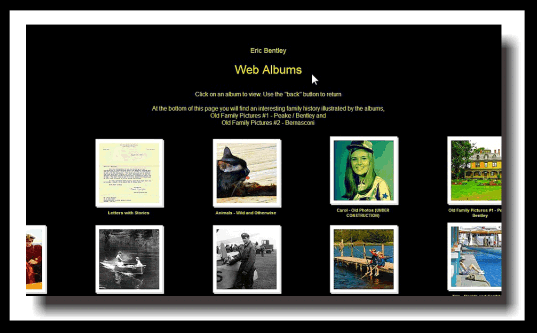
At the bottom of this page you will find an interesting family history illustrated by the albums,
Old Family Pictures #1 - Peake / Bentley and
Old Family Pictures #2 - Bernasconi
July 31, 2013
Out of personal interest, I followed two branches of my family tree and found two amazing stories.
Until I did some research on this I didn’t realize how well known the stories of my ancestors were and more information is widely available through books, Wikipedia and various sites on the internet. However, be forewarned that there is a lot of information out there that is confused and/or incorrect. I believe what is contained here is essentially correct, but please don’t hesitate to correct me on anything not so.
a) For simplification, Great-Great-Great Grandfather is abbreviated as G3 Grandfather, etc.
b) Spelling of names is as it was at the time, ie Bettie/Betty, Ester/Esther, Robinson/Robertson.
c) Please refer to the photos in the above web photo albums for more information.
E.B.
|
In the seventeenth century...
Europe was divided by religious conflict. With the New World opening up, many families and groups ventured across the ocean in the small sailing ships of the day to avoid persecution.
These stories of my ancestors begin in those times.
|
Part One: Charles Bentley. Dad’s Side of the Family
Chapter 1: The Robinson Family Settles in the New World.
“Blue Ridge Mountains, Shennendoah River, life is old there, older than the trees...”
John Denver - “Country Roads”
 In about the year 1700, James Robinson and his wife Ester left Northern Ireland for the New World to escape religious persecution. James and Ester were my great-great-great-great-great-great (G6) grandparents. The Robinson family was originally from Scotland and claimed to be descendants of the Robertsons of Struan. James would have been my G6 Grandfather on my father’s side and the Robinsons first settled in Lancaster County, Pennsylvania. James and Ester had eight children, John, William (my G5 Grandfather), James, Samuel, Thomas, Joseph, Ann, and Elizabeth (Bettie).
In the late 1730's James was looking for greener pastures and sent his eldest son John to Virginia to search for new land. John located and purchased a parcel of about 800 acres from George Robinson (perhaps a brother of James) in the area of what was later known as “the Big Spring Tract” on the south fork of the Roanoke River above what is known today as Elliston, Virginia. The deed was made out in John’s name which later led to numerous legal problems when John was killed by the Indians and died without a will.
In the early 1740's James made the move to Virginia with his family. This was truly the American frontier on the very edge of settled territory. The land was in the Blue Ridge Mountains in the far Western portion of Virginia in what at the time was Shawnee Indian territory.
When we think of the Wild West of Indian fame we tend to conjure up visions of Texas, Arizona, Wyoming and other Western States. But in the mid 1700's, this was the far west of white settlement. This is a historic area, not far from where Virginia meets Kentucky and Tennessee. Davy Crockett was born just over the border in Tennessee and one of James son’s, John was married to a Crockett. George Washington also frequented the area and the Robinson’s homestead bas built along the Great Wagon Road also known as the Wilderness Trail established by Daniel Boone.
These were true frontier days and the threat of Indian attack was an ever present and constant danger for these early settlers. The stories of James and his family read as though they came from a novel about life on the frontier and in fact, it was the stories of the Robinsons and their neighbours that has been the inspiration for many of the books and movies written about the settlers and the Indians of that time.
Chapter 2: Bettie Robinson Draper - Captured by the Shawnee
In 1754 William Robinson’s sister Bettie, my G5 Grand Aunt married ‘Long’ John Draper and that same year they welcomed their new baby into the world at their homestead in Draper’s Meadows. Draper’s Meadows was the first settlement west of the great Allegheny divide (near present day Blacksburg, Virginia).
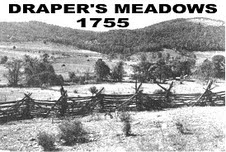 While isolated, the people of the Draper's Meadows settlement were reasonably happy, prosperous and contented. They were busy clearing and improving their lands, adding to their herds, building houses, and increasing their comforts. Others, influenced by their favorable reports, were coming in and settling near them. They were intent on laying the foundations of a growing and prosperous community.
But it was an unstable time and the Indians were a constant threat. Disaster struck one summer evening on July 30th, 1755 when Bettie’s husband John and his brother-in -law William Ingles were out harvesting their crops, quite some distance from the homestead and too far away to realize what was happening until they saw the ominous signs of smoke rising from the direction of the settlement. By then it was too late.
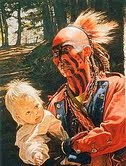 Bettie had been out in her yard in Draper’s Meadows when suddenly a Shawnee war party swooped into the settlement. Bettie yelled a warning to the others as she ran to her house to rescue her young baby. She quickly grabbed her child and ran for the woods. But Indians were too quick for her and one of them fired off a shot fracturing her right arm causing her to lose her grip on her child. She quickly snatched up the baby with her left hand and continue to make a break for it, but she was quickly overtaken by the Indians who grabbed the child from her. The raiders then proceeded to toss the baby back and forth between them while other 'braves' threw tomahawks at it using the poor child for target practice in front of the wounded and terrified mother. Tiring of this game, one Indian grabbed the child by the feet and brutally swung it into the logs of their cabin smashing its skull and brutally killing the baby in front of its horrified mother.
The Indians then gathered up their spoils, set fire to the village and rode off taking several of the settlers with them including Bettie Robinson Draper, her sister-in-law Mary Ingles and Mary’s two sons. Mary was nine months pregnant at the time.
 For weeks they trekked hundreds of miles through the wilderness and Mary consoled her devastated sister-in-law Bettie and tended to her wounds. The Indians instructed Mary how to bathe and poultice the broken arm with the steeped leaves of the wild comphry plant, and to dress the wounds with a salve made from the comphry plant and deer fat. It was in the Indians best interests to keep their captives in good health so that they could use their labours and ransom them back to their families if the opportunity presented itself.
While searching the woods for the plant, Mary began contemplating an escape, however she felt she couldn’t leave her helpless children. Mary was in the final stages of pregnancy by now and because of this she was allow to ride so as not to slow the Indian’s progress. However even with her broken arm Bettie was forced to walk. After travelling for a month they finally reached the main home of the Shanwnee at the mouth of the Sonhioto, or Scioto River.
There was a great celebration at the return of the war party and, as was the custom, the Indians held a festival where their captives were stripped naked and forced to “run the gauntlet”. This was not an unusual practice for Indian tribes of the day and was a widely used 'sport' to separate the weak from the strong captives. The Shawnee formed two long rows of warriors, women, the elderly and children and the line stretched for several hundred feet and each Indian held a stick, club or other weapon. The naked victims were then forced to run between the two lines with the Indians beating them unmercifully from either side. Many, if not most, did not survive this torture.
 Women were not spared from this ordeal, however because Mary was about to give birth she was exempted. Not so Bettie. She was stripped naked and forced to be the first one to make the run and if she didn’t finish, she knew she would be forced to start over. Wounded with her broken arm causing her great pain she was led to the line of savages. The natives were standing around excitedly talking about what was to come, when suddenly Bettie came bursting through the line with every bit of speed she could muster catching many of the natives off guard and she made it through the first part of the line relatively unscathed. But that didn’t last long and soon the line became aware of her run and she was being hit repeatedly.
About third of the way through she was clubbed violently on the nose and fell on her back and a dog grabbed her viciously by the ankle. She knew it was death to give up so she struggled to her feet with blood streaming from her nose and took off on a run once again still being hit on all sides by the Shawnee. Suddenly someone struck a severe blow to her injured arm staggering her as another clubbed her in the head and dropped her in her tracks.
The Shawnee continued to beat her unmercifully as she lay there. It was move or die. A woman was standing beside her holding a lance. Quickly Bettie grabbed the lance, hauled herself to her feet and took off on a mad run and against all odds finished the gauntlet badly beaten, but alive. The two other captives forced to make the run, Henry Lenard and James Cull, didn’t survive the ordeal and were killed.
 After a few weeks at the Shawnee town deals were made and the captives were divided up among the tribe. Bettie and Mary were split up and Mary was separated from her children. Soon after, With her children no longer a factor, Mary Ingles saw her chance to escape and after over forty days travelling hundreds of miles through the rough Indian territory she eventually made it back to Draper’s Meadows where she related the story of her ordeals. The Mary Ingles story has been immortalised on stage, screen and in a number of books including the best selling novel “Follow the River”, the ABC movie by the same name and the 2004 film “The Captives”.
Bettie was still a prisoner among the Indians. When separated from Mary at Scioto, she was taken up to the Chillicothe settlement, where she was adopted into the family of an old Chief who had recently lost a daughter. Although kindly treated, not long after she thought she saw her chance to escape. But she was recaptured and was condemned to the usual penalty for escape - death by burning at the stake. But the old Chief concealed her for a time, until he was able to use his authority and influence to eventually to secure her pardon. Since escape was now out of the question Bettie set to work earnestly to secure the favour and regard of the Indian family and the tribe in an effort to make her fate as tolerable as possible.
She taught the Indians to sew and to cook, and was ever willing and ready to nurse the sick or the wounded, and was regarded as a "heap good medicine squaw." By these means she soon proved her value to the tribe and her treatment became much more kind and considerate.
Six long years had passed since her capture and since her involuntary parting from Mary at Scioto. During this time her husband John Draper had personally made several trips, and had often sent agents to try to find and ransom her, but all without success. By1760 John was convinced that he would never see his wife again and while still grieving her loss, he married Bettie’s now widowed sister-in-law.
But the following year, 1761, much to the Draper’s surprise, Bettie’s location with the Shawnee was discovered and the marriage was hastily annulled. Some months later a treaty between the whites and Indians was being held somewhere on the border to end the Cherokee war. John Draper attended this treaty meeting and met the old Chief in whose family his wife was living. After much negotiation and a heavy ransom was paid, Bettie's freedom was obtained. The once more happy couple set out and returned to their home at Draper's Meadows and eventually moved to Draper’s Valley near New River.
Chapter 3: William Robinson and the Indian Wars
 In 1721 G5 Ggrandfather William met a ‘pretty little fair-haired, blue-eyed Welsh girl’ named Margaret Gorrill (various spellings) and married her. William, Margaret and their family lived on Goose Creek near New River and William was put in charge of building and maintaining roads in that region. Their farm was near what is today Shawsville, in Montgomery County, Virginia. Eventually, George Hancock purchased the property and the historic "Farthingay" mansion that still stands today.
But during the time William’s sister Bettie was being held captive, the Indian raids continued and the area in which the rest of the Robinson family lived was a prime target. In 1721 G5 Ggrandfather William met a ‘pretty little fair-haired, blue-eyed Welsh girl’ named Margaret Gorrill (various spellings) and married her. William, Margaret and their family lived on Goose Creek near New River and William was put in charge of building and maintaining roads in that region. Their farm was near what is today Shawsville, in Montgomery County, Virginia. Eventually, George Hancock purchased the property and the historic "Farthingay" mansion that still stands today.
But during the time William’s sister Bettie was being held captive, the Indian raids continued and the area in which the rest of the Robinson family lived was a prime target.
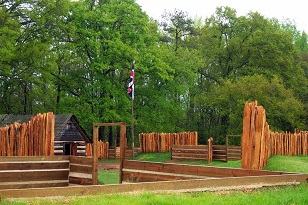
In 1756 the Indians had been raiding the New River area and many of the residents including the Robinsons had taken shelter in Fort Vause. Fort Vause was a minimally fortified dwelling, located at the western edge of present Shawsville. It was built under the direction of Col. Ephraim Vause, an early settler on the Roanoke River. He surrounded his home with a 100-foot square, 15-foot high wall of strongly built palisades, enclosing barracks and cabins and garrisoned by 70 local troops.
The French and Indians made their way toward Williamsburg, Virginia and raids were becoming more common in the area. They arrived at Fort Vause about the 16th of June 1756 and stayed in the area for over a week before they finally attacked on June 25th, 1756.
That summer day, barely a year after the Draper’s Meadows massacre, the fort was suddenly overrun and destroyed by a force of 20 French Canadians and 206 Indians. While Vause and most of his men were away from the Fort, the French, Shawnee, Miami and Ottowa troops first attacked at about 9:00am whereupon the French demanded that those in the surrender of those in the fort. Supposedly refused and within an hour the Fort was over-run and set afire.
Twenty-four settlers were either killed or captured. Many of the surviving residents of the fort were tortured on the spot. Mrs. Vause, two of her daughters and other family members were captured. One of Vause's daughter's or daughter in law's was scalped, but lived with an open unhealed wound cut into her sinus that she kept stuffed full of cotton. Most of the livestock at the fort was slaughtered and the raiders carried off as much as they could pack on the settler’s horses. Bettie’s four brothers were all at the Fort when it was attacked. John was killed and brothers William, Thomas, and Samuel were all wounded and fourteen others were taken away as captives. William was wounded in the neck and ripped the sleve from his shirt to stop the bleeding. Brother Thomas had a cut on his head and a knife wound in his ribs.
It is believed that William never fully recovered from his wounds and died in 1765. His brother Thomas sold his land to Samuel Crockett and moved on. He later lost his life at the “big defeated Camps” on the other side of Cumberland Mountain. All his family were either killed or taken prisoner when attacked by the Indians.
The following year, in 1757 George Washington then a Major in the Virginia Militia, arrived on the scene and supervised the rebuilding of the Fort.
Chapter 4: Lieutenant Colonel Joseph Robinson and the American Revolution
In 1742, about the time the Robinson’s arrived in Virginia, William and Margaret had a son, Joseph, G4 Grandfather. It is not known where Joseph was during the attack on Fort Vause or how he survived but when he was 22 he married Leila (Lilly) Whitley and Joseph and Leila eventually ended up in Prince Edward Island but there much more to the story before that.
Joseph was a farmer, fisherman and surveyor and was educated in Virginia for the ministry in the Presbyterian Church. Unfortunately Joseph became involved in some sort of scandal involving a women named “Cotton” and the church. So in 1769 Joseph and Lilly decided to moved from Virginia to the Camden district of South Carolina where he held the position of deputy surveyor and through time became a successful plantation owner. He and the Chreokee worked together which in later years helped to save his life when the rebels put a price on his head.
 Together they built a fish dam on the Broad River that ran through his land and this later became the site of the Battle of Fish Dam Ford where General Sumpter was attacked during the Revolution.
 At the outbreak of the American Revolution, Joseph was a Major with the South Carolina Royalists militia and in 1775 he was ordered by Governor Lord William Campbell to march against the rebels in the Ninety-Six District. He advanced with a party of men and fought the insurgents to a stand-off at the Battle of Ninety-Six Court-House. Robinson took over the town, fortified the jail and courthouse and besieged the rebels for two days before accepting their surrender. This was the first land battle of the American Revolution south of New England.
However the rebels did not keep to their agreement and at the same time Governor Campbell had been forced to abandon his office and make his own retreat. Robinson and his men suddenly found themselves stranded in the west without money or supplies. They disbanded and made their individual escapes as best they could. A price was put on the Major’s head but with the help of the Chreokee, Joseph made his way through the Creek Nation to Pensacola, Florida, then went to St. Augustine, where rejoined joined the Regiment of South Carolina Royalists under Colonel Innes at St Johns River in East Florida 1778.
Meanwhile his wife and daughters fared worse. The rebels radided the plantation stole their horses, cattle, sheep, household furniture, clothing, arms, wheat, corn, and everything they could carry with them. Then they burned the house and outbuildings to the ground. The Robinsons also owned another house and property in the District of 95 and it was also plundered and torched by the rebels. Leila and her young children narrowly escaped into the woods and with the help of their faithful slaves, travelled many hundreds of miles mostly at night with no food or shelter, through Indian territory, all the while evading the rebels. Eventually they made their way back to Leila’s father's family farm in Virginia.
 In May, 1778, Colonel Robinson was appointed Lieutenant-Colonel of the South Carolina Royalists, and in July it was decided that this corps should consist of eight companies of 50 rank and file each. With this regiment he was present at the battle of Stono Ferry, 12 June, 1779 and also fought in Florida, Georgia and South Carolina. A number of times his adversary was the infamous Francis Marion known as the Swamp Fox - played by Leslie Nielson in the TV series of the same name. Wrote Robinson, “I was in several engagements against the enemy at the Alligator Bridge in East Florida, at Dr. Bundstone’s plantation in Georgia, at New Port Meeting house in Georgia, at Stono Ferry in South Carolina and afterwards at the Reduction of Sunbury Fort in the Province of Georgia and the Fortification of Charles Town in South Carolina.”
Leila Robinson, returned to South Carolina from Virginia and accompanied her husband in the evacuation of Charleston by the British. They fled to East Florida where they intended to settle, only to find that shortly after their arrival the Colony had been given over to Spain and that they would be included in the 10,000 loyalists in that Province who were unwanted there and were being deported. The harassed Robinson family, along with many other Loyalists from the Southern Colonies, now sought refugee in the West Indies.
Once again disaster struck and they were shipwrecked off the coast of Florida and they took to the lifeboats. When their lifeboat capszed, their faithful slave once again came to their rescue and got them to shore. While they survived they lost the rest of their meagre belongings. “A slave who accompanied them to the Island (PEI) and lived to the age of 103, delighted to tell how he saved the lives of Mrs. Robinson and the children when sharks upset a boat in which they were being taken ashore in the West Indies.”
 Finally in 1784 Colonel Joseph Robinson and his family reached Jamaica. But they found the heat unhealthy and unbearable. So after a year's stay they were decided to move again and looked to the north. With this object in view, they now set sail for that asylum of so many American loyalists, New Brunswick , where they lived for some time before leaving for Shelbourne, NS along with twenty other loyalists. Finally in 1784 Colonel Joseph Robinson and his family reached Jamaica. But they found the heat unhealthy and unbearable. So after a year's stay they were decided to move again and looked to the north. With this object in view, they now set sail for that asylum of so many American loyalists, New Brunswick , where they lived for some time before leaving for Shelbourne, NS along with twenty other loyalists.
Chapter 5: Lieutenant Colonel Joseph Robinson Comes to Prince Edward Island
In 1789 Colonel Joseph Robinson was invited to settle at Charlottetown, Prince Edward Island by his friend, Colonel Edmund Fanning, then lieutenant-governor of the Island and formerly commanding officer of the loyalist corps, the King's American Regiment. On October 4th 1789 the Robinsons and their slaves finally landed on Prince Edward Island. John and Amelia Byers were two of four slaves brought to Prince Edward Island with Colonel Joseph Robinson. Robinson’s other slave's were Peter and Sancho Byers, John (Black Jack) Byer's brothers. Peter and Sancho were caught stealing bread and were hanged in 1815 on Gallow’s Hill in Charlottetown, the present site of the Inn on the Hill Hotel. John and Amelia had four children baptized at St. Paul’s Anglican Church in Charlottetown and the Byers family still lives on PEI.
While in PEI, Leila was quite taken aback one day when she encountered one of the men who were involved in burning and looting their plantation back in South Carolina. This tends to show that the “rebels” in many cases were simply crooks and thugs out stealing what they could. The Robinsons leased a 1,000 acre tract of land in the Charlottetown area from Sir James Montgomery and eventually Joseph became involved in the landowner’s rights battle against absentee landlords.
In 1790 Robinson became Speaker of the Assembly and remained so for five years. Later he was Assistant Justice of the Supreme Court and a member of the executive Council. From there he went on to establish his own law practice until his death in 1807. Leila lived until 1823.
Leila and Joseph had three daughters. Rebecca was born Sept 27, 1770 and married Robert Hodgson June 17, 1797, her son was Sir Robert Hodgson.
Matilda was born November 5, 1777 and was my G3 grandmother. Both Rebecca and Matilda were babies when Leila escaped the rebels in South Carolina and made her way on foot to Virginia. They later survived the Florida shipwreck and the voyages from Florida to Jamaica and the trip from Jamaica to New Brunswick.
Elizabeth, the youngest daughter was born in New Brunswick in 1788 and died unmarried.
Matilda married Ralph Brecken. One of her daughters married Donald MacDonald, president of the Legislative Council of Prince Edward Island, and a son of this marriage was Sir William Christopher MacDonald of Montreal, whose munificent gifts to McGill University and Macdonald College remain as monuments to his memory. I would guess that this was the MacDonald family of MacDonald Tobacco fame who had the large stone summer mansion in Tracadie that has been in one of my close friend’s family for about the last 80 years.
Matilda Robinson Brecken other daughter was the mother of Barbara Leila Alice Brecken my great-great grandmother who married James Ellis Peake, my great-great grandfather.
Chapter 6: James Ellis Peake and Family
John Brecken, a Loyalist, settled in Charlottetown, Prince Edward Island, on 26 July 1784. He was accompanied by his wife Ann and son Ralph. Shortly after their arrival, John established John Brecken & Company, a mercantile business, on the corner of Queen and Water Streets. He also invested heavily in real estate. John became a member of the House of Assembly in 1785 and was a member of the Grand Jury in Prince Edward Island in the 1790's. John died in England on 6 March 1827 leaving much of his property on Prince Edward Island to his grandsons, John and Ralph.
Ralph Brecken, son of John, senior and a G3 grandfather, was born in 1770. He was a merchant and a leading Island exporter in the firm of Brecken & Company. He was a member of the House of Assembly and was appointed Speaker of the House in 1812. He was also a Lieutenant of the Queen's County Militia and a Justice of the Peace. He died on 1 July 1813. After his death, his wife Matilda Robinson, daughter of Lt. Colonel Joseph Robinson whom he had married in 1797, continued to operate the family business until her death in 1842. They had seven children: Anna Matilda, John, Jane Rebecca, Mary Williams, Ralph, Barbara Leila Alice (G2 Grandmother), and Matilda. John and Ralph were both involved in Brecken & Company. Barbara Leila Alice (1807-1870) married James Ellis Peake on 19 July 1838.
My great-great grandfather James Ellis Peake (1797-1860), son of George Peake Sr, arrived in Charlottetown, Prince Edward Island, from Plymouth, England, in 1824. He quickly established himself as an important shipowner, shipbuilder, and merchant, perhaps operating as an extension of the family business of Peake and Sons in Plymouth. James imported a wide variety of goods from either a parent company or this branch of the family business in England.
James and Barbara Leila Alice had six children: Elizabeth, Alice Brecken, James Jr., Great Grandfather George , Ralph Brecken, and Fanny. Due to his ill health, James and his family returned to Plymouth in 1856 apparently leaving his affairs in the hands of Mr. James Moore of Charlottetown. James died in East Stonehouse, County Devon, in 1860.
In 1863, the James Peake Jr. returned to Prince Edward Island and picked up the threads of his father's business as Peake Bros. & Company. At this point James built the mansion known as Beaconsfield which has been restored and along with the Peake’s Wharf area are some of Charlottetown’s most significant historical sites.
The family business continued to operate at a reduced scale into the 1900's. James personal fortune was greatly reduced 1882 with the collapse of the Bank of PEI in which he had invested heavily. The following year he lost his home, Beaconsfield, to the mortgagor, William Cundall. James married Edith Alice Constance Haviland, daughter of Thomas Heath Haviland Jr., on 30 August 1866. They had six children. James left PEI ca. 1888 in hopes of reestablishing his fortune. He went first to St. Paul, Minnesota, and then to Victoria and Vancouver, British Columbia. James died in Vancouver in 1895.
The story of the Peake’s and Beaconsfield is in the web album and also covered HERE
Ralph Peake, accompanied by his mother Alice, returned to Prince Edward Island in 1866. He married Matilda Haviland and he was a partner in Peake Bros. & Company until his death on 11 January 1879 at the age of 34.
Great Grandfather George Peake married Alice Rebecca DeBlois on 28 July 1870 and George continued to operate the Peake business interests after his brother James left PEI in 1888.
George’s son was Ernest DeBlois Peake, my Grandfather. I never knew Ernest and knew nothing about him until I started to research this history. I did know that Dad was originally from the Peake family, but was never particularly interested.
Ernest and his wife Adelaide Wiggins (a nurse and my grandmother) had three children, Cyril, Vera and Charles (Dad). Dad was born in 1909 but unfortunately his mother, Adelaide, died just a few weeks after giving birth to my father. As a single working man, Ernest had his hands full looking after two young children and a baby. W.E. Bentley was a friend and well known lawyer and he and his wife Florrie lived not far away. I believe that Charles spent much time at the Bentleys as they looked after the young child. As the Bentley’s could not have children of their own and they had grown attached to young Charles it agreed that the Bentleys would adopt him.
Dad was a lawyer who left the practice of law for a position with the Royal Trust Company and was their manager in Charlottetown for many years. He married Eileen Bernasconi in 1938 and they had three children, Eric (me, 1944), John (1947), and Margot (1955).
|
Part Two - Eileen Crawley Bernasconi - Mom’s Side of the Family
Chapter 1: The Payzants
This narrative parallels the story of Bettie Robinson in an almost uncanny way. Numerous books have told the story of Marie Anne Payzant. Among them, “A Passion for Survival: The True Story of Marie Anne and Louis Payzant in 18th Century Nova Scotia” by Linda Layton,“The Payzant ... Families In North America”, “The Foreign Protestants and the Settlement of Nova Scotia”, “Story of a Nation: Defining Moments in our History”, “The Journal of the Reverend John Payzant (1749-1834)”, “100 More Canadian Heroines: Famous and Forgotten Faces”. The Marie Payzant story also was contained in our readers in school as well as our Canadian History books. Well known Canadian author, Margaret Atwood also wrote a fictionalized account of Marie adventures:
LINK
 Less than a year after Bettie Robinson Draper had been kidnapped by the Shawnee a similar event took place one thousand miles to the north in Nova Scotia. In May of 1756 , on Payzant Island in Mahone Bay Louis Payzant knew by his barking dogs that something was wrong. He grabbed his rifle and rushed to his door where he was shot through the heart and fell in a pool of his own blood. His horrified wife, Marie Anne, ran to his side only to be met by ten wooping Indian warriors who rushed into their cabin brandishing tomahawks. One Indian stopped long enough to rip Louis’s scalp from his head right in front of his terrified family and callously stuck in his belt as a trophy.
The Maliseet raiding party grabbed the dry goods that the murdered merchant was planning to sell, herded the remaining Payzant family into their canoes and torched the buildings. The attackers also killed the family servant and Payzant’s young son who had naively guided the Indians to the Island. Marie and the children were in a state of shock as the savages forced them into their canoes.
In the early 1700's the Payzants left their native home in Normandy to avoid persecution of the Huguenots and fled to the British held Island of Jersey. Louis was a prosperous merchant and married Marie Anne Noget in 1740. They had four surviving children when Louis learned the British Government was looking for several hundred Protestant Hugunots to settle Nova Scotia. Marie and Louis were my Great 6 Grandparents on my mother’s (Eileen) side.
The Payzants sailed for the new world in the Summer of 1753 initially settling in Lunenburg and then migrating to their own island in Mahone Bay in 1756. As was the Robinson family, the Payzants were caught up in the Seven Year’s War that lasted from 1756 to 1763. Similarliy to what the French did with the Shawnee in Virginia, they secured support of the Malaseet Indians in the Maritimes and used them in their war against the British. It was the French that paid the natives to attack the Payzant settlement. But the irony of the situation is that the Payzants were actually French, a fact that may have saved their lives when the Indians discovered that their captives were actually French, not English as they expected.
For at least four days Marie and her terrified children endured a frightening trek from Payzant Island to Saint Anne’s Mission (In the vicinity of Fredericton NB) in French territory. The captives were given little or nothing to eat during their journey and were forced to lay flat in the bottom of the warrior’s canoes for days at a time. Youngest son, Louis (G5 grandfather) later recounted that they were treated most cruelly. On arrival at Saint Anne’s they watched the Maliseet warriors celebrate their successful raids by dancing and drumming around their campfires as they showed off their booty and captives.
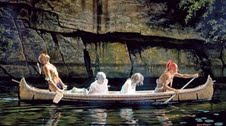 The Maliseets adopted the four Payzant children and gave them new names. To Marie’s horror, she was then separated from her children and sent by canoe and overland all the way to the capital of New France, Quebec City, a journey of hundreds of miles through mountains, forests and rivers. Although nothing is mentioned about it in any of the narratives, it is quite likely that Marie was raped by the Indians because she was about a month pregnant when she arrived in Quebec.
On her arrival, the French were surprised to find that Marie was French, but they were not so pleased when they discovered she was Huguenot. Little is known about the four long years she stayed in Quebec but there are various rumours that Marie and General Montcalm may have had some kind of relationship. The fact that she seemed to be well treated by the French tends to indicate she was not treated as a prisoner and the fact that they eventually arranged for the successful recovery of her children by paying a substantial ransom certainly suggests that she received unusual treatment. For many years the story went that she was actually a long lost sister of Montcalm’s, but this has since been disproven. But one might imagine that the story might well have been concocted to cover up that she and the General may have had a romantic relationship. Something had to account for her special treatment.
In any event, Marie pleaded with the Bishop of Quebec to be reunited with her children, but the Bishop insisted that she convert to Catholicism first. With no option, she signed the papers on December 8, 1756. Just after Christmas, at the age of 45, she gave birth to her last child, Louise Cathrine Payzant and the baby was baptised in the Roman Catholic cathedral.
The following summer Marie’s children were brought to Quebec to be reunited with their mother. In June of 1759 the family was excited to see British ships arriving at Quebec and son John actually witnessed the Battle of the Plains of Abraham where both General Wolf and General Montcalm succumbed to their wounds on the battlefield and control of Canada shifted from the French to the English. After the battle and the defeat of the French the Payzants suffered through the chaos and food shortages that followed the war. Finally, after the spring ice breakup in 1760 the Payzants were able to sail back home to Nova Scotia where they were once again free to live their life as they wished and practice the Protestant religion without fear of persecution. Marie was granted a 500 acre farm in the Protestant community of Falmouth Nova Scotia. By the time Marie died in 1796, she was living with her son Louis, my Great 5 Grandfather, and his family.
Chapter 2: The Bernasconi’s and Crawleys
Lets skip forward a few generations to the Bernasconi’s and Crawley’s. In 1838 Dr. Edmond A. Crawley founded the well reputed Acadia University in the Annapolis Valley of Nova Scotia
Edmond Crawley was my great-great grandfather. His son, E. S. Crawley, married Annie Payzant and their daughter, ‘Nell’ (Helen Bernal) Crawley married Perley Bernasconi. Nell and Perley were my mother’s (Eileen) parents and Annie Payzant was mother’s grandmother. My father, Charles Bentley was a graduate of Acadia University and later obtained his law degree from Dalhousie Law School in Halifax where he met Eileen.
Perley Bernasconi was born in Saint John, New Brunswick and his parents came from Chiasso, Switzerland on the Swiss-Italian border. His Grandfather was Colonel Costantino Bernasconi. (Born 11/04/1820 in Chiasso, died 06/20/1902 Chiasso. Son of Louis, a landowner, and Nolfi Carolina)
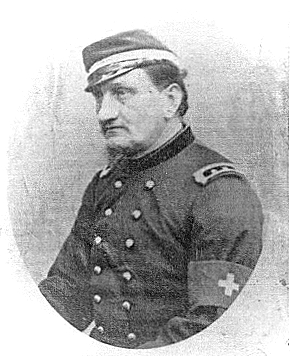 Costantino entered military service in 1843 and saw active service under General Garabaldi in the Italian-Austrian wars and at one point worked closely with Garibaldi himself. After graduating in law in Modena, he was active as a lawyer and notary in Chiasso, between 1852 and 1857 and until 1877 he was mayor of the city. He was a leading figure in the Radical Party in Ticino in the second half of the nineteenth century.
He was deputy to the Grand Council (1853 and 1893-1902), the National Council (1863-72 and 1884-93) and the Council of States (1874-75). In the fall of 1890 he participated in the conference convened by the authorities in the Bern Federation to bring peace among the parties in Ticino. In the army he reached the rank of colonel in 1871. A colonel in the Swiss Army was the equivalent to a General in other countries armies.
Costantino was a friend of the famous Swiss sculptor, Vincenzo Vela. In the Constantino Bernasconi family chapel in the Chiasso cemetery there is a statue crafted by Vela in 1850 titled the “Angel of the Resurrection”. “ Vela was a native of Switzerland and “...one of the most gifted of modern sculptors; his work is especially remarkable for repose and grandeur of expression.”
When my sister Margot visited Chiasso a few years ago she visited the square in the centre of the town named after our Great-great grandfather, “Piazzo Col. Costantino Bernasconi”. When she dropped into the town offfices and told them who she was received the VIP treatment and was given several mementos of her visit including a large book containing the history of the town - in Italian.
Chapter 3: The Bernals
After a recent trip to Jamaica (March 2014) I was reminded that we had Jamaican connections on both sides of the family. This was particularly interesting as this is the second unexpected connection between Dad’s side of the family and Mom’s.
Not only were women from both sides of our ancestors captured by Indians, (Payzants on Mom’s side and Robinson’s on Dad’s side), but also we had great, great, great grand parents from both Dad's & Mom's) sides of the family living in Jamaica during the 1780's - the Robinson's & Bernal's.
In 1784, Great (x4) Grandfather Col. Joseph Robinson and family spent a year in Jamaica after escaping the rebels during the American Revolution. During the same period, G(x3) Grandfather Jacob Israel Bernal was prospering as a merchant in Jamaica and in 1788 purchased the sugar plantations known as Richmond Old Works Estate and Richmond New Works Estate. Those plantations remained in the family until 1911 when sold by the Duke and Duchess of St. Albans. The Duchess was a Great grand daughter of Jacob, our G (x3) grandfather.
I knew nothing of this while in Jamaica and took this picture of the luxury housing development now standing on the site of the plantation. Compare the hills in the background of the picture I snapped through a bus window to those in the painting of the Plantation. The picture is just one more coincidence. Also, my son Chris spent several months working in Jamaica when he was in his late teens. He was working less than 20 miles from the site of the former plantation. Another coincidence and Jamaican connection.
LINK

 .
.
In 1809 Richmond Estate was listed as being 1,416 Acres, having 328 Slaves and 185 Head of Cattle. Jacob Israel Bernal who had gone on to become a prominent West Indian Merchant in London, died at his Town House in Fitzroy Square, London, England in 1811 and left all of his Real Estate in England and his Plantations and Slaves in Jamaica to his only son, Ralph Bernal (1785-1854).
Ralph was a highly successful Barrister and Politician in England. He was Member of Parliament, and also a leading Collector of Art and Antiques in London.
Ralph, brother of our great great grandmother Esther, was a British Whig politician and art collector. His parents, Jacob Israel Bernal and wife Leah da Silva, were Sephardi Jews of Spanish and Portuguese origin, but he was baptised at St Olave Hart Street in London.
During his youth he became an actor and he performed to acclaim in several works by William Shakespeare during which time he gained a reputation for oratory.
He was Member of Parliament (MP) for Lincoln 1818 to 1820 and MP for Rochester from 1820 to 1841 and again from 1847 to 1852. From 1842 to 1847 he was MP for Weymouth and Melcombe Regis.
He was one of the very first Jews to be socially accepted into English High Society. When he died in 1854 he left his entire estate in England and his Plantations in Jamaica, including Richmond Estate in St. Ann, to his son Ralph Bernal-Osborne, Esq. from Ireland.
Ralph Bernal-Osborne (1808–1882), like his father, was a very wealthy Landowner who owned more than 13,000 acres of land in Ireland. Before his death in 1882, he gave Richmond Estate in Jamaica to his younger daughter, Grace Bernal-Osborne (1844-1926), as part of her Dowry on the occasion of her marriage in 1874 to His Grace William Amelius Aubrey DeVere Beauclerk (1840-1898), the 10th Duke of St. Albans. They sold the property in 1911.
Now for a bit of trivia: Actress Olivia Wilde is Ralph Bernal's great, great, great, great, granddaughter. Or in other words, her great, great, great, great, great, grandfather was Jacob Bernal who was also our great, great, great, grandfather (Guess that makes her our cousin?) Olivia has starred in House, The Black Donnellys, The O.C. and many other movies and TV shows. LINK
 Wilde was born in New York City. Her mother, Leslie Cockburn (née Redlich), is an American-born 60 Minutes producer and journalist. Her father, Andrew Cockburn, a journalist, was born in London to British parents but raised in Ireland; her uncles, Alexander Cockburn and Patrick Cockburn, also worked as journalists. Wilde's older sister, Chloe Cockburn, is a civil rights attorney in New York; her aunt, Sarah Caudwell, was a writer, and her paternal grandfather, Claud Cockburn, was a novelist and journalist.
Wilde's father's upper-class British ancestors lived in several places at the height of British Empire, including Peking (where her paternal grandfather was born), Calcutta, Bombay, Cairo and Tasmania (one of her paternal great-great-grandfathers, Henry Arthur Blake, was Governor of Hong Kong). Wilde's father's ancestors include abolitionist and Anglican minister James Ramsay, politician George Arbuthnot, lawyer, judge, and literary figure Lord Cockbury, Lord Provost of Edinburgh Sir William Arbuthnot, and Sir Thomas Osborne. Wilde's ancestry includes English, Irish, Scottish, Manx, and German; she is also of 1/64th Sephardi Jewish descent (from Spain and Portugal) through Ralph Bernal (1783–1854), a British Whig politician and actor.
|
Conclusion
The foregoing is meant to be supplemented and illustrated by the pictures in the accompanying Picasa web albums where more information is contained in the captions of the various photos. Of all my ancestors I have just followed a couple of the lines. I find it amazing that the stories from the Seven Years War period are so parallel, yet occurred 1,000 miles apart. And yet to think that at one point in the 1780's both the Robinson family and the Payzant family were both in Nova Scotia and less than 100 miles apart. Not only that, but the fact that both the Robinsons on Dad’s side and the Bernals on Mom’s side both lived in Jamaica (of all places) during the 1780's.
Perhaps when time and desire permits, I will look at some of the other interesting branches of the families. There are so many trails to follow and in compiling these stories I came on some snippets of facts that tend to indicate that there are other trails worth pursuing. Any corrections and additional information are welcomed.
Eric Bentley
Charlottetown
April 8, 2014
To email me: Send E-Mail
|
|


